Summary
The clarinet family consists of several instruments that play crucial roles in the orchestra. The B♭ clarinet is the primary and most commonly used member, known for its versatility and extensive range.
The clarinet section typically sits in the woodwind section, usually between the oboes and bassoons. Their ability to blend with both woodwinds and brass makes them essential for creating orchestral colors and textures.
In concert bands and wind ensembles, clarinets often take on roles traditionally held by string instruments in orchestras. The clarinet section's rich, warm timbre and extensive range make it particularly well-suited to carry melodic lines and provide harmonic support, effectively serving as the "violins" of the wind band. Their ability to produce both lyrical, singing passages and quick, technical runs makes them indispensable in band literature.
Registers
All clarinets share the same register and dynamic tendencies with minor exceptions:


Chalumeau register (E3 to B♭4)
The lowest register, known for its rich, dark, and full-bodied sound
Throat register (F♯4 to B♭4)
A transitional register that can be challenging to control, often requiring special attention to maintain evenness. The tendency is for these notes to sound airy and thin.
Clarion register (B4 to C6)
The middle register, characterized by a bright, clear, and projecting tone. Many solos tend to exist in this register.
Altissimo register (C♯6 and above)
The highest register, featuring a brilliant and penetrating sound, though requiring advanced technique to control effectively.
Types of Clarinets
(high-low)
Piccolo Clarinet (in Ab)
The Piccolo Clarinet in Ab, is the highest-pitched member of the clarinet family in regular use. It sounds a perfect fourth higher than the standard Bb clarinet. Known for its bright, penetrating tone, it's particularly effective in military band music and certain orchestral works where an extremely high, brilliant clarinet sound is desired.


Notable uses of the Ab piccolo clarinet include:
Ravel's "Bolero" - Features a memorable solo passage that showcases the instrument's distinctive timbre
Mahler's Symphony No. 1 - Used effectively in the third movement
Stravinsky's "The Rite of Spring" - Employs the instrument for its piercing high register capabilities
Sopranino Clarinet (in D & Eb)
The Sopranino Clarinet in D or Eb is a small, high-pitched member of the clarinet family that sounds a minor third (Eb) or major second (D) higher than the standard Bb clarinet. Known for its bright, penetrating tone quality, it is less commonly used than its Ab counterpart but still appears in several notable compositions.

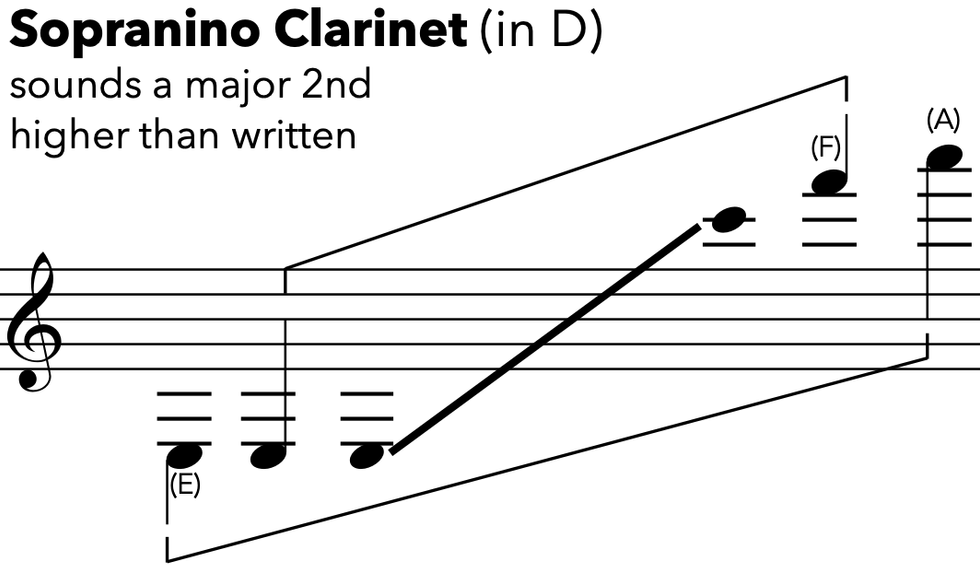


Notable works featuring the Sopranino Clarinet include:
Ravel's "L'Enfant et les Sortilèges" - Uses the D sopranino clarinet for its distinctive timbre
Stravinsky's "Threni" - Employs the Eb sopranino clarinet in this late-period work
Berg's "Lulu" - Features the Eb sopranino clarinet in its complex orchestration
While less common in modern compositions, these instruments are still manufactured and used in specific repertoire where their unique tonal qualities are desired.
Clarinet (in Bb)
The Bb Clarinet, also known as the soprano clarinet, is the most common member of the clarinet family. It features a cylindrical bore, single reed, and complex key system that gives it remarkable agility across its wide range. The instrument is known for its warm, expressive tone and exceptional versatility.
The clarinet's ability to produce both smooth, legato passages and quick, articulated runs makes it particularly effective in both solo and ensemble settings. Its range spans over three octaves, allowing composers to utilize its different registers for varied tonal colors.


Notable works featuring prominent clarinet parts include:
Mozart's Clarinet Concerto in A Major, K. 622 - A cornerstone of the clarinet repertoire that showcases the instrument's lyrical qualities
Brahms's Clarinet Quintet in B minor, Op. 115 - Demonstrates the clarinet's ability to blend with strings while maintaining its distinct voice
Gershwin's "Rhapsody in Blue" - Opens with the famous glissando that has become one of the most recognizable clarinet passages
Howard Shore's "The Lord of the Rings" - The clarinet carries the pastoral Shire theme, creating a warm, folklike character that represents the hobbits' homeland
Weber's Clarinet Concertos No. 1 and 2 - Virtuosic works that exploit the instrument's technical capabilities
Clarinet (in A)
The A Clarinet is pitched a semitone lower than the Bb clarinet and is particularly favored in orchestral music. It produces a slightly darker, warmer tone than its Bb counterpart. While both A and Bb clarinets are similarly constructed and played using the same fingerings, they serve different purposes in the repertoire, with the A clarinet often preferred in works in sharp keys.


Notable works featuring the A clarinet include:
Mozart's Clarinet Concerto in A Major, K. 622 - Originally written for the basset clarinet in A, now commonly performed on the modern A clarinet
Brahms's Clarinet Quintet in B minor, Op. 115 - Takes advantage of the A clarinet's darker timbre
Tchaikovsky's Symphony No. 5 - Features prominent A clarinet solos, particularly in the first movement
Rachmaninoff's Symphony No. 2 - Contains a famous third movement solo for A clarinet
Stravinsky's "The Firebird" - Utilizes the A clarinet's unique tonal qualities in its orchestration
Basset Horn (in F)
The basset horn is a member of the clarinet family pitched in F, positioned between the A clarinet and bass clarinet in range. It features an extended lower range compared to standard clarinets and produces a distinctively dark, rich tone quality. The instrument's curved or angled neck and metal bell give it a characteristic appearance.
While less common in modern compositions, the basset horn remains an important instrument for performing historical works, particularly those from the Classical period. Its warm, mellow tone quality makes it especially effective in chamber music settings.



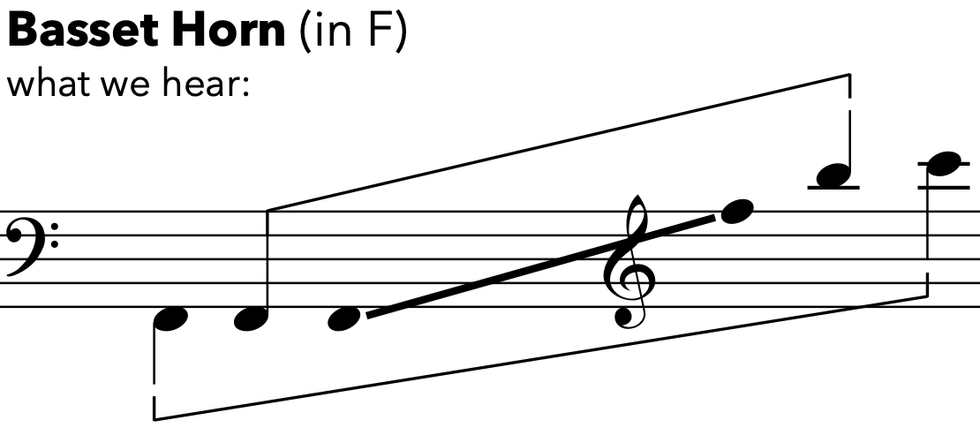
Notable works featuring the basset horn include:
Mozart's Requiem - Uses two basset horns prominently throughout the work
Mozart's "Gran Partita" Serenade (K. 361/370a) - Features two basset horns in this landmark wind ensemble piece
Richard Strauss's "Daphne" - Employs the basset horn for its unique tonal color
Mozart's "La Clemenza di Tito" - Contains significant basset horn parts, including notable obbligato passages
Alto Clarinet (in Eb)
The Alto Clarinet in Eb sounds a perfect fifth lower than the Bb soprano clarinet. It serves as a middle voice in clarinet choirs and concert bands, bridging the gap between soprano and bass clarinets. The instrument features a characteristic curved neck and bell, similar to the bass clarinet but smaller in size.
The alto clarinet provides a warm, mellow tone that blends well with other woodwinds while maintaining the agility of the soprano clarinet. Though less common in modern ensembles, it remains an important voice in certain repertoire.

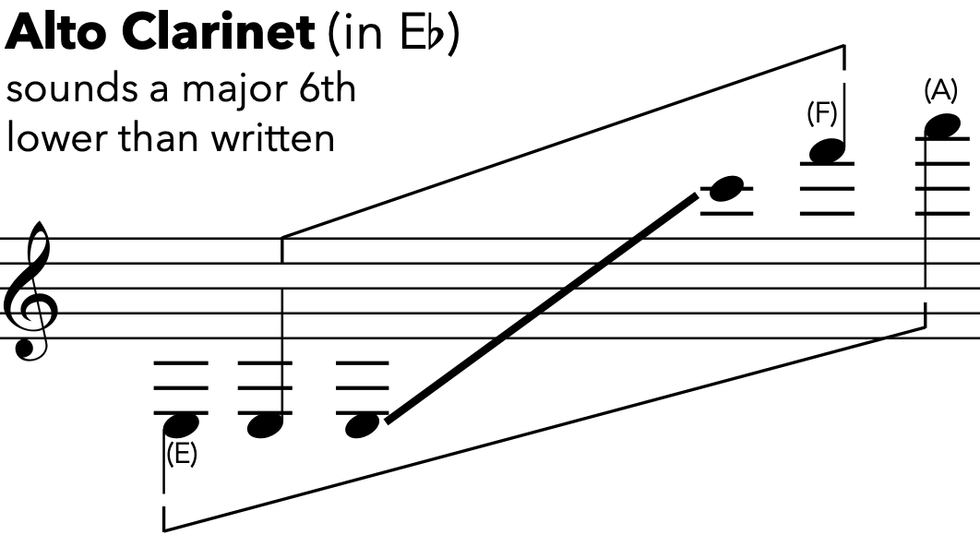


Notable works featuring the alto clarinet include:
Grainger's "Lincolnshire Posy" - Uses the alto clarinet as an important middle voice in the wind band texture
Holst's "Second Suite in F for Military Band" - Features the alto clarinet in both melodic and harmonic roles
Vaughan Williams's "English Folk Song Suite" - Employs the alto clarinet to enhance the rich woodwind scoring
Hindemith's "Symphony in B-flat for Concert Band" - Includes significant alto clarinet parts that contribute to the work's complex harmonies
Bass Clarinet (in Bb)
The Bass Clarinet in Bb sounds an octave lower than the standard Bb clarinet and features an extended lower range down to a written E3 (sounding D2). Professional models often extend down to written C3 (sounding Bb1), giving them additional flexibility in the low register. The instrument is characterized by its rich, full-bodied sound, particularly effective in its lowest register.
The bass clarinet often serves multiple roles in ensemble settings:
As a solo instrument, particularly in contemporary music where its wide range and distinctive timbre are valued
As a bass voice in clarinet choirs and woodwind ensembles
As harmonic support in full orchestra, providing depth to woodwind textures


Notable works featuring the bass clarinet include:
Wagner's "Tristan und Isolde" - Features prominent bass clarinet solos, especially in Act II
Stravinsky's "The Rite of Spring" - Contains significant bass clarinet passages that showcase its low register capabilities
Ticheli's "Blue Shades" - Features extensive bass clarinet solos that emphasize its jazz influences and technical capabilities
Mahler's Symphony No. 6 - Uses the bass clarinet effectively in both solo and ensemble contexts
Shostakovich's Symphony No. 7 "Leningrad" - Employs the bass clarinet for its dark, dramatic character
Contra Alto Clarinet (in EEb)
The Contra Alto Clarinet in EEb sounds an octave lower than the alto clarinet and two octaves plus a major sixth lower than written pitch. It serves as an important bass voice in clarinet choirs and concert bands, providing a rich, deep foundation with its powerful low register.
Key characteristics include:
Extensive low range, typically to written E3 (sounding G0)
Large size requiring a floor peg or neck strap for support
Warm, resonant tone quality particularly suited to bass lines
While less common in modern compositions, the contra alto clarinet remains an important member of large concert band and clarinet choir settings, where its unique timbral qualities and low range capabilities are particularly valuable.


Notable works featuring the contra alto clarinet include:
Grainger's "Lincolnshire Posy" - Uses the contra alto clarinet to provide deep foundation in wind band setting
Holst's "First Suite in Eb for Military Band" - Features the instrument in its bass voice role
Reed's "Russian Christmas Music" - Employs the contra alto clarinet for its rich low register
Contrabass Clarinet (in BBb)
The Contrabass Clarinet in BBb is the lowest-pitched member of the clarinet family, sounding two octaves lower than the standard Bb soprano clarinet. It features a long, curved metal neck and an upturned metal bell. The instrument requires significant air support but produces a rich, powerful bass sound that can extend the bottom range of any ensemble.
Key characteristics include:
Extensive low range, typically to written E3 (sounding D1)
Large size requiring floor support via an endpin or stand
Powerful projection in its low register
Complex key mechanism similar to other members of the clarinet family




Notable works featuring the contrabass clarinet include:
Schoenberg's "Gurre-Lieder" - One of the earliest major works to incorporate the instrument
Ligeti's "Lontano" - Uses the contrabass clarinet to create deep, atmospheric textures
Stockhausen's "Licht" cycle - Features prominent contrabass clarinet parts
Notation
Modern clarinet notation follows these conventions:
Clef
All clarinets read treble clef exclusively
Bass clefs may appear in the score for the lower clarinets, but the performer's part should always be written in treble clef
Range
Ledger lines are preferred over 8va markings
Octave markings may appear in the score, but the performer's part should always be written with ledger lines
Techniques
Basic Techniques:
Vibrato: Controlled oscillation of pitch or intensity
Single tonguing: Basic articulation using "tu" or "du" syllables
Ornaments:
Trills: Rapid alternation between two adjacent notes
Tremolos: Rapid alternation between two notes separated by more than a major 2nd
Most minor thirds, major thirds, and perfect fourths are possible
Mordents: Quick alternation of the main note with the note above or below
Grace notes: Quick decorative notes before the main note
Extended Techniques:
Double tonguing: Rapid articulation using "tu-ku" or "du-gu" syllables
Flutter tonguing: Rolling the tongue while playing (like rolling an 'R')
Multiphonics: Producing multiple notes simultaneously through special fingerings
Key clicks: Percussive sounds created by quickly closing keys without blowing
Slap tonguing: Sharp, percussive attack created by releasing suction against the reed
Singing while playing: Produces a complex harmony or beating effect
Glissando: Sliding between notes by gradually opening or closing tone holes
This technique becomes increasingly difficult on the lower clarinets
Pitch bends: Gradual changes in pitch through embouchure control
Air sounds: Playing without reed vibration to create whisper-like effects
Quarter tones: Pitches between standard semitones using special fingerings
Subtone: Playing with a softer, airier tone by adjusting embouchure pressure
Construction and Design
Professional clarinets are traditionally crafted from African Blackwood (grenadilla), while some modern instruments use high-quality synthetic materials. Beginner models typically use hybrid plastics. Professional instruments feature silver or nickel-silver keys and posts mounted on the wooden body.
The instrument consists of five main components that work together to produce its distinctive sound:
Mouthpiece and Reed
The mouthpiece, typically made of hard rubber or plastic, holds a single reed made from cane or synthetic materials
The reed vibrates against the mouthpiece's flat surface (called the table) to produce sound
A ligature holds the reed in place
Barrel
A short, cylindrical joint that connects the mouthpiece to the upper joint
Affects the instrument's tuning and tonal qualities
Usually made of grenadilla wood or synthetic materials
Upper Joint
Contains many of the instrument's keys and tone holes
Features complex keywork for the left and right hands
Houses the register key that facilitates playing in higher registers
Lower Joint
Contains additional keys and tone holes
Works in conjunction with the upper joint to produce the instrument's full range
Typically made of the same material as the upper joint
Bell
The flared end piece that projects the sound
Contributes to the instrument's resonance and tonal character
May be made of wood or synthetic materials to match the body
The bells of larger clarinets are typically made of metal
Nomenclature and Language
A person who plays the clarinet is called a clarinetist (also spelled "clarinettist" in British English). This term derives from combining "clarinet" with the suffix "-ist" to denote someone who has mastered or regularly performs on the instrument.
Below is a reference table showing the terminology for clarinets across major European languages, as commonly found in musical scores and orchestral parts:
English | Spanish | French | German | Italian |
Piccolo Clarinet | Clarinete piccolo | Petite clarinette | Piccoloklarinette | Clarinetto piccolo |
Sopranino Clarinet | Clarinete sopranino | Clarinette sopranino | Sopranino-Klarinette | Clarinetto sopranino |
Clarinet in Bb | Clarinete Sib | Clarinette Sib | B-Klarinette | Clarinetto Sib |
Clarinet in A | Clarinete La | Clarinette La | A-Klarinette | Clarinetto La |
Basset Horn | Corno di bassetto | Cor de basset | Bassetthorn | Corno di bassetto |
Alto Clarinet | Clarinete alto | Clarinette alto | Altklarinette | Clarinetto alto |
Bass Clarinet | Clarinete bajo | Clarinette basse | Bassklarinette | Clarinetto basso |
Contra Alto Clarinet | Clarinete contralto | Clarinette contralto | Kontraaltklarinette | Clarinetto contralto |
Contrabass Clarinet | Clarinete contrabajo | Clarinette contrebasse | Kontrabassklarinette | Clarinetto contrabbasso |
In orchestral scores and parts, these instruments are often abbreviated:
Piccolo Clarinet: Pic. Cl.
Sopranino Clarinet: Sop. Cl.
Clarinet in Bb: Cl., Cl. in Bb
Clarinet in A: Cl. in A
Basset Horn: Bst. Hn.
Alto Clarinet: A. Cl.
Bass Clarinet: B. Cl.
Contra Alto Clarinet: C.A. Cl.
Contrabass Clarinet: Cb. Cl.
Multiple clarinets in an orchestra are typically numbered (e.g., Cl. 1, Cl. 2, Cl. 3)
Historical Development
The clarinet's development can be traced through several key periods, each representing significant milestones in the instrument's evolution from its humble beginnings to the sophisticated woodwind instrument we know today. The fascinating journey of the clarinet spans over three centuries, during which it underwent numerous transformations in design, mechanism, and playing capability, influenced by innovative craftsmen, performers, and the changing demands of musical styles across different eras:
Early Origins (Late 1600s)
The clarinet evolved from a single-reed instrument called the chalumeau. Johann Christoph Denner of Nuremberg is credited with developing the first true clarinet around 1690 by adding a register key to the chalumeau, enabling the instrument to play in higher registers.
Classical Era (1750-1820)
During this era, composers like Mozart began writing extensively for the clarinet. The instrument underwent significant improvements, including the addition of more keys to facilitate chromatic playing. Mozart's Clarinet Concerto (1791) was written for Anton Stadler's extended-range basset clarinet.
Müller System (1810)
Iwan Müller developed a new key system with 13 keys, allowing for better intonation and easier cross-fingerings. This system became the standard for German and Austrian clarinetists.
Boehm System (1843)
Hyacinthe Klosé and Auguste Buffet adapted Theobald Boehm's flute key system to the clarinet, creating what is now known as the Boehm system clarinet. This revolutionary design featured:
Improved key placement for better ergonomics
Ring keys allowing for better acoustic properties
More consistent intonation across all registers
Modern Era (1900s-Present)
The clarinet family expanded to include various sizes and pitches. Manufacturers like Buffet Crampon, Selmer, and Yamaha have continued to refine the instrument's mechanics and acoustics while maintaining the basic Boehm system design.
Key innovations in modern clarinet manufacturing include:
Development of synthetic materials for student instruments
Improved bore designs for better projection and intonation
Enhanced key mechanisms for greater reliability
Introduction of adjustable thumb rests and neck straps for ergonomic comfort
Stylistic Differences
Clarinet playing styles vary significantly across different musical traditions and cultures. These stylistic differences often influence the choice of equipment, particularly in mouthpiece selection and reed strength, to facilitate the specific techniques and tonal qualities desired in each tradition.
Here are some of the most distinctive approaches:
Classical Western:
Emphasizes clean, focused tone with minimal vibrato
Precise articulation and controlled dynamics
Strict adherence to written notation
Klezmer:
Characterized by expressive "laughing" and "crying" effects
Heavy use of glissandi and bent notes
Distinctive ornaments like the krekhts (sob) and tshok (laugh)
Often employs a brighter, more penetrating tone
Jazz:
Wide range of tonal approaches, from smooth to rough and edgy
Extensive use of vibrato as an expressive device
Emphasis on improvisation and personal style
Distinctive articulation patterns for swing feel
Turkish:
Often uses alternative fingerings for microtonal effects
Employs specific ornaments unique to Turkish classical music
Frequently incorporates sliding effects between notes
Greek:
Similar to Turkish style but with regional variations
Strong emphasis on dance rhythms
Often played with more aggressive articulation
Balkan:
Heavy use of ornaments and trills
Complex rhythmic patterns
Often employs a more nasal tone quality
Sources
Baines, Anthony. "Woodwind Instruments and Their History." Dover Publications, 1991.
Blatter, Alfred. "Instrumentation and Orchestration." 2nd ed., Schirmer Books, 1997.
Brymer, Jack. "Clarinet." Yehudi Menuhin Music Guides, 1976.
Hoeprich, Eric. "The Clarinet." Yale University Press, 2008.
Lawson, Colin. "The Cambridge Companion to the Clarinet." Cambridge University Press, 1995.
Lawson, Colin. "The Early Clarinet: A Practical Guide." Cambridge University Press, 2000.
Pino, David. "The Clarinet and Clarinet Playing." Dover Publications, 1998.
Rendall, F. Geoffrey. "The Clarinet: Some Notes upon Its History and Construction." W.W. Norton, 1971.
Rice, Albert R. "The Clarinet in the Classical Period." Oxford University Press, 2003.
Shackleton, Nicholas. "The Development of the Clarinet." The Cambridge Companion to the Clarinet, Cambridge University Press, 1995.
Weston, Pamela. "Clarinet Virtuosi of the Past." Emerson Edition, 2002.