Summary
The saxophone is a versatile woodwind instrument invented by Adolphe Sax in the 1840s. Known for its distinctive warm, expressive tone, the saxophone bridges the gap between woodwind and brass instruments, combining a single-reed mouthpiece with a conical brass body.
The saxophone has had a profound impact on many musical genres, particularly jazz, where it became a defining voice through legendary players like Charlie Parker, John Coltrane, and Coleman Hawkins. Its ability to produce both smooth, melodic lines and powerful, energetic phrases has made it equally at home in classical music, rock, funk, and contemporary compositions.
The saxophone family includes several members, with the alto and tenor saxophones being the most commonly used. Each type offers unique tonal characteristics while maintaining the instrument's signature expressiveness and versatility. In modern orchestral and band settings, the saxophone adds a distinctive color to the ensemble, enriching the overall musical texture with its warm, singing quality.
Registers
All saxophones share the same register and dynamic tendencies with minor exceptions:


Low register (written B♭3 to C♯5):
Rich, full-bodied tone with great resonance
Excellent for powerful melodic lines and foundational parts
Requires careful breath support to maintain clarity
Playing the lowest notes (Bb3-D4) requires careful control and technique. A beginner should not be expected to play these quietly
Middle register (written D5 to C♯6):
Most flexible and controllable range
Balanced timbre ideal for melodic passages
Offers excellent dynamic control
The transition between low and middle registers, called "crossing the break," requires special consideration when composing for saxophone
High register (written D6 and above):
Bright and projecting sound
Requires precise embouchure control
Often used for dramatic effect and climactic passages
Types of Saxophones
(high-low)
Sopranino Saxophone (in E♭):
The smallest and highest-pitched member of the saxophone family, known for its bright, penetrating sound. While less commonly used than other saxophones, it adds a unique color to saxophone ensembles and contemporary compositions.


Notable works featuring the sopranino saxophone:
Luciano Berio's "Sequenza VIIb" - An adaptation of his oboe sequenza that showcases the sopranino's technical capabilities
Michael Colgrass's "Urban Requiem" - Features the sopranino saxophone as part of a saxophone quartet
Philip Glass's "Facades" - Sometimes performed with sopranino saxophone, though originally written for soprano
Soprano Saxophone (in B♭):
The soprano saxophone has a bright, sweet tone quality and is particularly agile in its upper register. While less common than the alto or tenor saxophone, it has gained prominence in both classical and jazz contexts. Its smaller size and higher pitch make it more challenging to play with proper intonation, requiring excellent embouchure control.

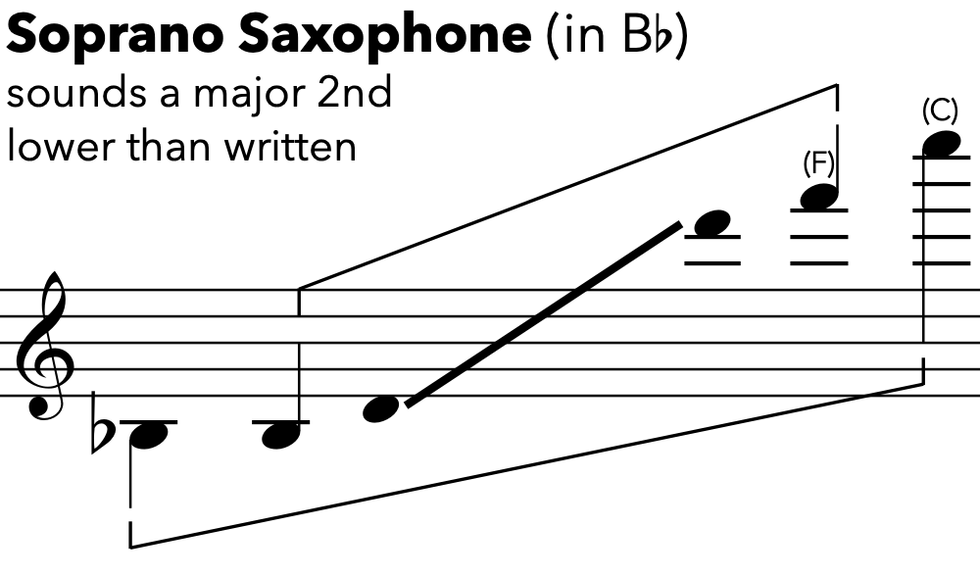


Notable works featuring the soprano saxophone:
Ravel's "Bolero" - Features a memorable soprano saxophone solo in the orchestral masterpiece
John Coltrane's "My Favorite Things" - Helped popularize the soprano saxophone in modern jazz
Steve Lacy's "Evidence" - Pioneering work featuring the soprano saxophone in avant-garde jazz
Claude Debussy's "Rapsodie" - Sometimes performed on soprano saxophone, though originally written for orchestra
Alto Saxophone (in E♭):
The alto saxophone is one of the most commonly used members of the saxophone family, known for its versatility and expressive capabilities. Its range and agility make it well-suited for both classical and jazz contexts. The alto saxophone has a brighter, more penetrating tone compared to its larger siblings, while maintaining the characteristic warmth of the saxophone family.


Notable works featuring the alto saxophone:
Jacques Ibert's "Concertino da Camera" - A cornerstone of the classical saxophone repertoire that showcases the instrument's technical and expressive capabilities
Alexander Glazunov's "Saxophone Concerto" - One of the earliest and most important concertos written specifically for the alto saxophone
Charlie Parker's "Ko-Ko" - A revolutionary bebop composition that demonstrated the alto saxophone's potential in modern jazz
Maurice Ravel's "Boléro" - Features a prominent alto saxophone solo that highlights the instrument's lyrical qualities
John Adams's "City Noir" - A contemporary orchestral work with significant alto saxophone parts that blend classical and jazz influences
Bernard Herrmann's "Taxi Driver" (1976) - Features a moody, noir-influenced alto saxophone score that perfectly captures the film's dark atmosphere
"Twin Peaks" theme by Angelo Badalamenti - Incorporates smooth alto saxophone lines that contribute to the show's mysterious mood
"The Nightmare Before Christmas" (1993) by Danny Elfman - Features expressive alto saxophone solos throughout the soundtrack, particularly in "Sally's Song" and "This is Halloween," adding a gothic jazz element to the film's unique musical atmosphere
Tenor Saxophone (in B♭):
The tenor saxophone is characterized by its warm, rich tone and versatility across musical genres. With a range slightly lower than the alto saxophone, it produces a fuller, more robust sound that has made it particularly popular in jazz and rock music. The tenor saxophone offers excellent projection and expressive capabilities, making it equally effective in both solo and ensemble settings.


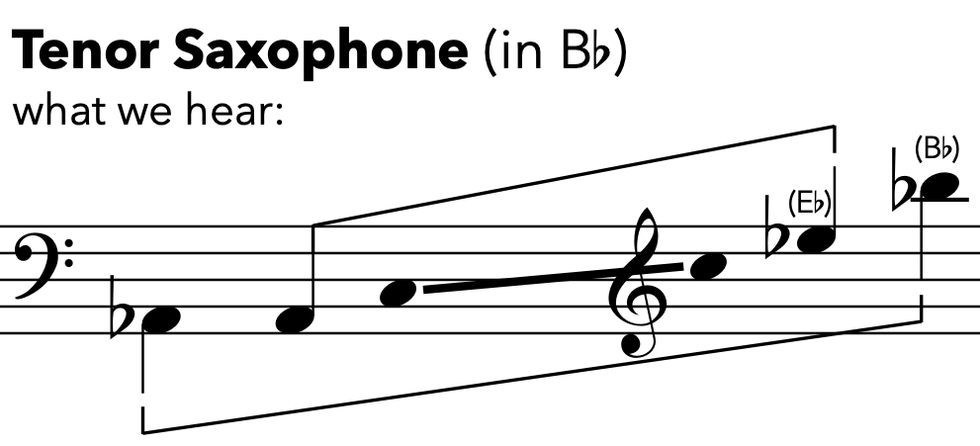
Notable works featuring the tenor saxophone:
Glazunov's "Saxophone Quartet" - Features prominent tenor saxophone parts that showcase the instrument's lyrical qualities
Villa-Lobos's "Fantasia for Soprano/Tenor Saxophone" - A significant piece in the classical saxophone repertoire
Philip Glass's "Façades" - Written for two soprano saxophones but often performed with tenor saxophones
John Coltrane's "Giant Steps" - A landmark recording that revolutionized saxophone technique and harmony
Sonny Rollins's "Saxophone Colossus" - Demonstrates the tenor saxophone's capabilities in bebop and hard bop styles
Coleman Hawkins's "Body and Soul" - A definitive tenor saxophone jazz ballad performance
"The Pink Panther Theme" by Henry Mancini - Features one of the most recognizable tenor saxophone melodies in popular culture
"Blade Runner" (1982) by Vangelis - Uses tenor saxophone to create a noir atmosphere in its iconic "Love Theme"
"Born to Be Blue" (2015) - Features extensive tenor saxophone work in its portrayal of jazz musician Chet Baker
"LA Confidential" (1997) by Jerry Goldsmith - Incorporates tenor saxophone to enhance its neo-noir atmosphere
Baritone Saxophone (in E♭):
The baritone saxophone has a rich, deep tone and serves as the bass voice in saxophone ensembles. Its powerful sound and expressive capabilities make it valuable in both classical and jazz contexts. While less commonly featured as a solo instrument than its smaller siblings, the baritone saxophone's distinctive voice adds depth and warmth to arrangements.


Notable works featuring the baritone saxophone:
Gustav Holst's "Second Suite in F" - Features prominent baritone saxophone parts in the military band setting
Gerry Mulligan's "Walking Shoes" - Pioneering work that established the baritone saxophone as a leading voice in cool jazz
Duke Ellington's "Sophisticated Lady" - Harry Carney's baritone saxophone work helped define the role of the instrument in big band jazz
Philip Glass's "Saxophone Quartet" - Demonstrates the baritone saxophone's role in contemporary classical music
Gil Evans/Miles Davis's "Porgy and Bess" - Features innovative orchestration with prominent baritone saxophone partsFilm and TV scores:
"The Simpsons" Theme by Danny Elfman - Features a distinctive baritone saxophone line that has become one of TV's most recognizable themes
"Catch Me If You Can" (2002) by John Williams - Uses baritone saxophone to enhance the jazz-influenced score
"The Incredibles" (2004) by Michael Giacchino - Incorporates baritone saxophone in its retro-styled jazz orchestration
"Better Call Saul" by Dave Porter - Features baritone saxophone in its noir-influenced soundtrack
Bass Saxophone (in B♭):
The bass saxophone is a large and rare member of the saxophone family that sounds an octave below the tenor saxophone. It produces a deep, powerful tone with a distinctive richness in its low register. Due to its size and weight, it requires significant physical strength and specialized breath control to play effectively. While less common in modern ensembles, it has found use in both classical and jazz contexts.


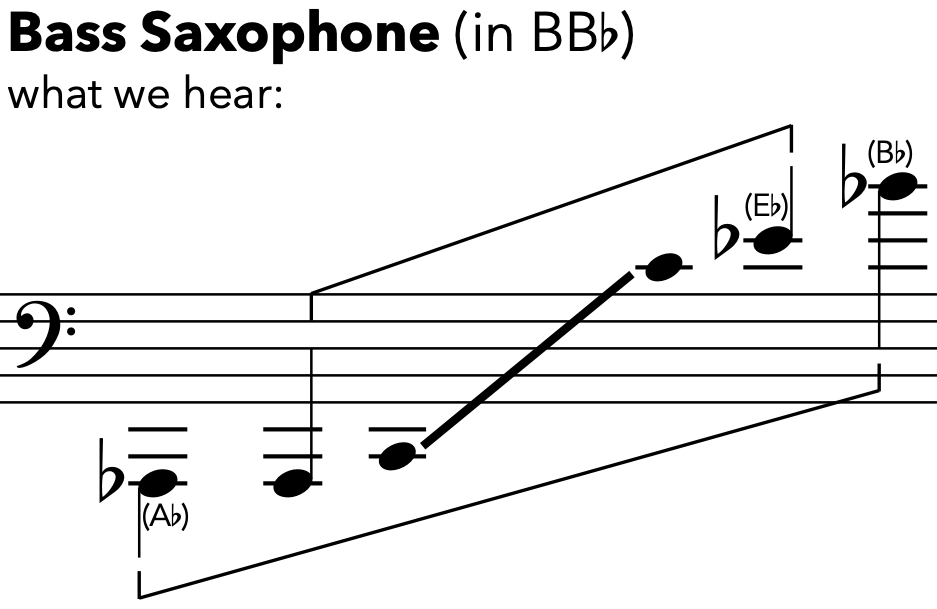
Notable works featuring the bass saxophone:
Percy Grainger's "Lincolnshire Posy" - Uses the bass saxophone to add depth to the wind band texture
Adrian Rollini's jazz recordings (1920s-1930s) - Pioneered the use of bass saxophone in early jazz, particularly in the California Ramblers
Scott Robinson's "Multiple Instruments" - Contemporary jazz performances featuring the bass saxophone as a lead instrument
Philip Glass's "Music in Twelve Parts" - Incorporates bass saxophone in its innovative minimalist composition
"Metropolis" (1927) score reconstructions - Some modern performances of Gottfried Huppertz's score include bass saxophone to enhance the film's industrial atmosphere
Contrabass Saxophone (in E♭):
The contrabass saxophone is the largest and lowest-pitched member of the saxophone family. It sounds an octave below the bass saxophone (two octaves below the tenor saxophone). Due to its enormous size - standing over 6 feet tall - and substantial weight, it requires exceptional breath support and physical strength to play. The instrument produces a remarkably deep, powerful sound that can reach into the lowest registers of any wind instrument.



Notable works featuring the contrabass saxophone:
Percy Grainger's "Dragons in the Sky" - One of the few orchestral works specifically written with parts for contrabass saxophone
Daniel Kientzy's "Sax-Blue" - A contemporary piece that explores the unique timbral possibilities of the contrabass saxophone
Anthony Braxton's "Composition No. 146" - Features the contrabass saxophone in an experimental jazz context
Deep Schrott - A German bass saxophone quartet that occasionally incorporates contrabass saxophone in their contemporary performances
Notation
Modern saxophone notation follows these conventions:
Clef
All saxophones read treble clef exclusively
Bass clefs may appear in the score for the lower saxophones, but the performer's part should always be written in treble clef
Range
Ledger lines are preferred over 8va markings
Octave markings may appear in the score for flute and especially piccolo, but the performer's part should always be written with ledger lines
Techniques
Basic Techniques:
Vibrato: Controlled oscillation of pitch or intensity
Single tonguing: Basic articulation using "tu" or "du" syllables
Ornaments:
Trills: Rapid alternation between two adjacent notes
Tremolos: Rapid alternation between two notes separated by more than a major 2nd
Most minor thirds, major thirds, and perfect fourths are possible
Mordents: Quick alternation of the main note with the note above or below
Grace notes: Quick decorative notes before the main note
Extended Techniques:
Double tonguing: Rapid articulation using "tu-ku" or "du-gu" syllables
Flutter tonguing: Rolling the tongue while playing (like rolling an 'R')
Key clicks: Percussive sounds made by clicking the keys without blowing
Multiphonics: Producing multiple notes simultaneously
Harmonics: Overblowing to produce higher partials of a fundamental note
Slap tonguing: Creating a percussive effect by using suction between the tongue and reed
Growling: Creating a rough sound by humming or growling while playing
Bisbigliando: Subtle timbral trills using alternative fingerings (not possible on all notes)
Singing while playing: Produces a complex harmony or beating effect
Pitch bends: Gradual changes in pitch through embouchure control
Subtone: Playing with a softer, airy tone by adjusting embouchure pressure
Construction and Design
The saxophone's fingering system shares significant similarities with both the clarinet and flute, as Adolphe Sax incorporated elements from both instruments in his design. The basic fingering pattern follows the Boehm system, which was originally developed for the flute and later adapted for woodwinds.
The saxophone's design incorporates several key features from the clarinet, including similar tone hole and key arrangements for the primary scale, palm key layouts for the upper register, and side key positions for alternate fingerings.
The saxophone also shares important design elements with the flute such as a similar octave key mechanism, consistent octave displacement when overblowing, and comparable cross-fingering patterns for chromatic notes.
The saxophone is constructed from brass and comprises several key components:
Neck and Mouthpiece:
Removable neck (crook) connects body to mouthpiece
Single-reed mouthpiece typically made from hard rubber or metal
Metal mouthpieces are typically used for jazz
Reed attached to mouthpiece with a ligature
Body:
Made from brass tubing formed into a conical shape
Features a curved neck (except for some soprano models)
Includes precision-engineered tone holes
Key Mechanism:
Complex system of keys, rods, and springs
Based on the Boehm system adapted for saxophone
Allows for ergonomic finger placement and technical facility
Bell:
Flared end of the instrument
Shape and size affect tone quality and projection
Often includes engraving and manufacturer markings
Nomenclature and Language
A person who plays the saxophone is referred to as a saxophonist across all English-speaking regions. Unlike some other instruments, there is no regional variation in the terminology. The term is derived from "saxophone" (named after its inventor, Adolphe Sax) combined with the suffix "-ist" denoting a player or practitioner.
In musical scores and parts, "saxophone" is commonly abbreviated as "Sax." with specific types indicated by their first letter (e.g., "A. Sax." for alto saxophone, "T. Sax." for tenor saxophone).
English | Spanish | French | German | Italian |
Sopranino Saxophone | Saxofón sopranino | Saxophone sopranino | Sopranino-Saxophon | Sassofono sopranino |
Soprano Saxophone | Saxofón soprano | Saxophone soprano | Sopran-Saxophon | Sassofono soprano |
Alto Saxophone | Saxofón alto | Saxophone alto | Alt-Saxophon | Sassofono contralto |
Tenor Saxophone | Saxofón tenor | Saxophone ténor | Tenor-Saxophon | Sassofono tenore |
Baritone Saxophone | Saxofón barítono | Saxophone baryton | Bariton-Saxophon | Sassofono baritono |
Bass Saxophone | Saxofón bajo | Saxophone basse | Bass-Saxophon | Sassofono basso |
Contrabass Saxophone | Saxofón contrabajo | Saxophone contrebasse | Kontrabass-Saxophon | Sassofono contrabbasso |
A player of any type of saxophone is referred to using the same pattern across languages:
Spanish: Saxofonista
French: Saxophoniste
German: Saxophonist
Italian: Sassofonista
Common abbreviations for saxophones in scores:
Sopranino Saxophone: Sno. Sax. or Spno. Sax.
Soprano Saxophone: S. Sax. or Sop. Sax.
Alto Saxophone: A. Sax.
Tenor Saxophone: T. Sax.
Baritone Saxophone: Bar. Sax. or Bari. Sax.
Bass Saxophone: B. Sax.
Contrabass Saxophone: Cb. Sax.
Multiple saxophones of the same type are typically numbered (e.g., A. Sax. 1, A. Sax. 2)
Historical Development
The saxophone was invented by Adolphe Sax, a Belgian instrument maker, in the early 1840s. Sax received the patent for his invention in 1846, after developing the instrument while working in his father's instrument workshop in Brussels. The saxophone was designed to combine the power of brass instruments with the agility of woodwinds.
The saxophone's versatility has led to its adoption in virtually every genre of music, from classical and military band music to jazz, rock, and contemporary classical compositions. Modern manufacturers continue to refine and improve upon Sax's original design while maintaining the essential characteristics that make the instrument unique.
Key periods in saxophone development:
1840s-1850s: Initial Development
Adolphe Sax creates the first saxophone in the early 1840s
Patent granted in 1846 covering a full family of saxophones
First public performance in 1844 at Paris Industrial Exhibition
1850s-1900: Military Band Era
French military bands adopt the saxophone in 1845
Rapid spread through European military bands
First saxophone classes established at Paris Conservatory
Saxophones become a staple in concert bands
1900-1920s: Early Jazz Period
Introduction to American jazz and vaudeville
Six Brown Brothers popularize saxophone ensembles
Development of new playing techniques for jazz
1920s-1940s: Golden Age
Jazz becomes mainstream, saxophone essential
Major technical improvements in manufacturing
Classical repertoire expands significantly
1950s-Present: Modern Era
Continued refinement of mechanical systems
Development of contemporary extended techniques
Expansion into various musical genres
Sources
Adler, Samuel. "The Study of Orchestration." 4th ed., W.W. Norton & Company, 2016.
Blatter, Alfred. "Instrumentation and Orchestration." 2nd ed., Schirmer Books, 1997.
Ingham, Richard. "The Cambridge Companion to the Saxophone." Cambridge University Press, 1998.
Kochnitzky, Léon. "Adolphe Sax and His Saxophone." Belgian Government Information Center, 1964.
Liebman, David. "Developing a Personal Saxophone Sound." Dorn Publications, 1989.
Londeix, Jean-Marie. "150 Years of Music for Saxophone." Roncorp Publications, 1994.
Rascher, Sigurd. "Top-Tones for the Saxophone." Carl Fischer, 1977.
Raumberger, Claus and Karl Ventzke. "Saxophone." Grove Music Online, Oxford University Press.
Rousseau, Eugene. "Marcel Mule: His Life and the Saxophone." Shell Lake Arts Center, 1982.
Segell, Michael. "The Devil's Horn: The Story of the Saxophone." Picador, 2006.
Teal, Larry. "The Art of Saxophone Playing." Summy-Birchard Inc., 1963.