Summary
The trumpet is a brass instrument characterized by its bright, powerful sound and versatile role in many genres of music. It consists of about 6.5 feet of brass tubing bent into a compact shape, with three piston valves that alter the length of the tubing to produce different pitches.
As one of the oldest musical instruments, dating back to ancient civilizations, the trumpet has evolved from simple signal instruments to a sophisticated orchestral and solo instrument. Its distinctive sound is produced by buzzing the lips into a cup-shaped mouthpiece, creating vibrations that resonate through the instrument's tubing.
Modern trumpets are most commonly pitched in B♭, though other variants exist. The instrument is essential in classical orchestras, jazz ensembles, military bands, and popular music, known for its ability to produce both brilliant fanfares and subtle, lyrical passages.
Registers
The trumpet, as a brass instrument, doesn't have registers in the same sense as woodwind instruments. Instead, its range is determined by the harmonic series or partials produced by varying the player's lip tension while maintaining the same valve combination.
Professional players can extend beyond these ranges using advanced techniques and specialized equipment. The exact range varies depending on the player's skill level and the specific trumpet type being used.
Compositionally, the trumpet's range can be divided into three main registers:


Low Register (F♯3 to C4)
Characterized by a rich, warm tone
Requires careful breath control to maintain clarity
Middle Register (C#4 to G5)
Most comfortable playing range
Produces bright, clear tones
Used extensively for melodic material
High Register (G#5 to C6 and above)
Brilliant and powerful sound
Requires advanced embouchure control
Often featured in dramatic passages and fanfares
Trumpets vs Cornets
While trumpets and cornets are similar brass instruments that share the same range and valve system, they have several key physical differences:
Bore Shape: Cornets have a more conical bore throughout their length, while trumpets maintain a cylindrical bore until the bell section. This gives cornets a mellower, warmer sound compared to the trumpet's brighter, more projecting tone.
Physical Length: Though both instruments have the same total tubing length, the cornet's tubing is wrapped more compactly, making it physically shorter than the trumpet.
Mouthpiece: Cornet mouthpieces are deeper and more V-shaped compared to trumpet mouthpieces, contributing to their darker tone quality.
Traditional Usage: Cornets were historically preferred in British brass bands and some early jazz, while trumpets became standard in orchestras and modern jazz.
These physical differences create distinct timbres. Cornets produce a warmer, mellower sound, while trumpets have a brighter, more piercing quality. This difference makes each instrument better suited for specific musical contexts. Trumpets excel in marching bands and outdoor performances, while cornets are often preferred for indoor settings where their softer tone is advantageous.
Types of Trumpets
(high-low)
Piccolo Trumpet (in Bb or A)
The piccolo trumpet is the highest-pitched member of the trumpet family, typically pitched in B♭ or A, sounding an octave higher than the standard B♭ trumpet. It features a compact design with shorter tubing and additional tuning slides that allow for quick key changes. Its bright, clear tone makes it particularly well-suited for baroque music and high register passages.


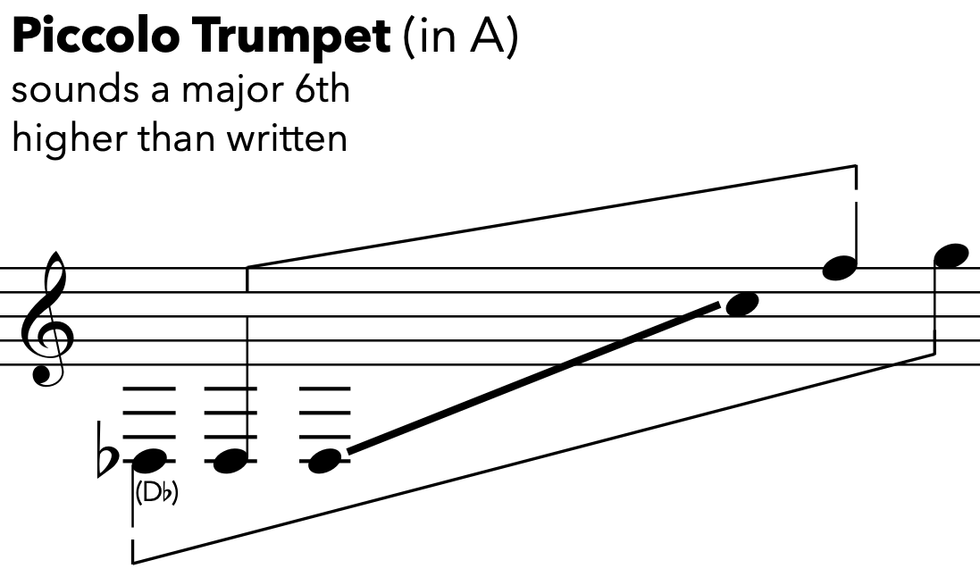


Notable works featuring the piccolo trumpet include:
Bach's Brandenburg Concerto No. 2: Features an extremely demanding trumpet part that is now commonly performed on piccolo trumpet
Beatles' "Penny Lane": Contains a famous piccolo trumpet solo performed by David Mason
Handel's "Messiah": The "The trumpet shall sound" aria is often performed on piccolo trumpet in modern performances
Bach's Mass in B Minor: Contains challenging high trumpet parts ideal for piccolo trumpet
Soprano Trumpet/Cornet (in Eb or D)
The E♭ and D trumpets are primarily used for performing baroque music, offering a brighter timbre suitable for high register playing.
While E♭ cornets are commonly used, particularly in British-style brass bands where they often serve as the principal voice, D cornets are relatively rare in modern performance. The E♭ cornet's higher pitch and brilliant tone make it well-suited for leading brass ensembles, but the D cornet's specific pitch serves a more limited purpose and is not commonly manufactured or used in contemporary settings.

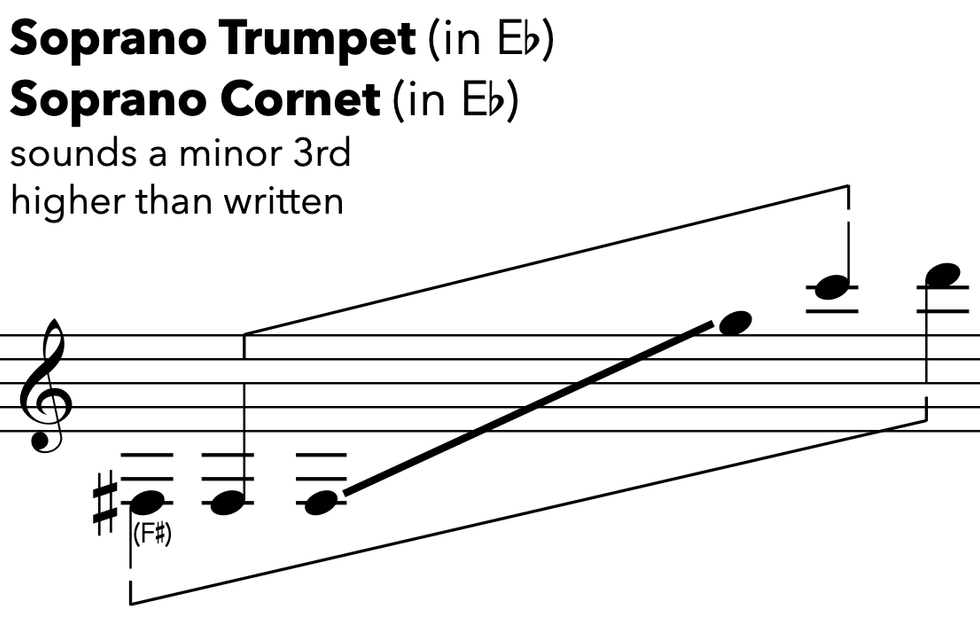





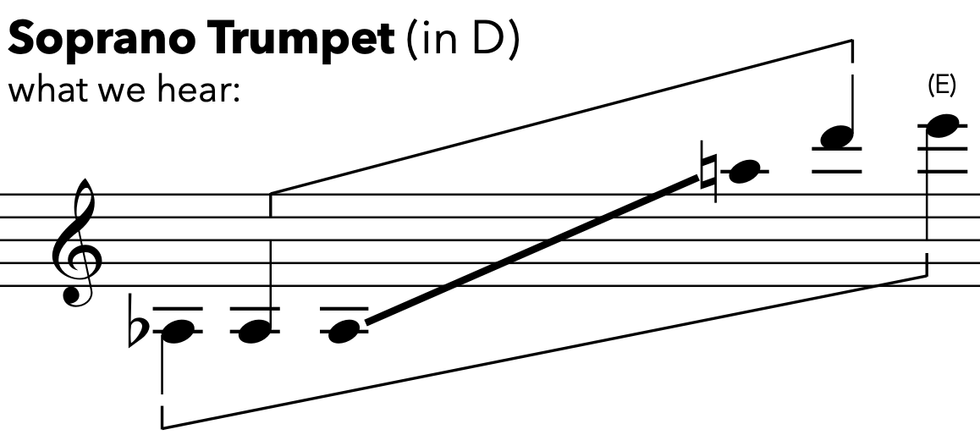
Notable works include:
Bach's Brandenburg Concerto No. 2: Originally for high trumpet in F, often performed on E♭ trumpet
Handel's "Let the Bright Seraphim": Commonly performed on D trumpet
Trumpet/Cornet (in Bb or C)
The standard B♭ trumpet is by far the most common type used today in orchestras, bands, and jazz ensembles. It combines excellent intonation with a bright, projected sound that works well in many musical contexts.



Notable examples featuring the B♭ trumpet include:
Haydn's Trumpet Concerto in E♭: Originally written for keyed trumpet, now commonly performed on B♭ trumpet
Mahler's Symphony No. 5: Features an iconic opening trumpet solo
Miles Davis's "Kind of Blue": Showcases innovative jazz trumpet playing
The C trumpet is preferred by many orchestral players, especially in American orchestras, for its slightly brighter sound and ease of reading concert pitch parts. Notable repertoire includes:
Stravinsky's "Petrushka": Features challenging trumpet passages often performed on C trumpet
Mussorgsky's "Pictures at an Exhibition": Contains prominent trumpet parts traditionally played on C trumpet
Herald Trumpet (in Bb)
The herald trumpet, also known as a fanfare trumpet, is a ceremonial variant of the B♭ trumpet characterized by its elongated straight design and often decorated with a banner or flag hanging from the bell. These trumpets are typically used in formal ceremonies, royal events, and military occasions.
Herald trumpets feature a longer, straight design compared to standard trumpets and are often adorned with ceremonial banners displaying heraldic designs or institutional insignia. They are used primarily for fanfares and ceremonial music, traditionally played in groups for maximum dramatic effect. These instruments are commonly featured at royal ceremonies and state occasions, military ceremonies and parades, Olympic Games ceremonies, and university graduations and formal academic events.
Pocket Trumpet (in Bb)
The pocket trumpet is a compact version of the standard B♭ trumpet, maintaining the same pitch and total tubing length but wrapped into a much smaller package. Despite its diminutive size, it produces essentially the same range of notes as a standard trumpet.
Key characteristics include:
Size and Portability: Approximately half the length of a standard trumpet when assembled, making it ideal for travel or practice in confined spaces
Sound Quality: While capable of producing similar notes, the tight wrapping of the tubing typically results in a slightly more constrained sound compared to full-sized trumpets
Primary Uses
Practice instrument when traveling
Educational tool for young students
Occasional use in jazz and experimental music
While pocket trumpets are legitimate instruments, they are generally not used in professional orchestral or ensemble settings, where standard B♭ trumpets are preferred for their superior projection and tonal qualities.
Flugelhorn (in Bb)
The flugelhorn, or soprano saxhorn, is a brass instrument similar to the trumpet but with a wider, more conical bore that produces a mellower, warmer sound. It shares the same valve system and range as the B♭ trumpet but features a larger bell and more conical tubing throughout its length.
The flugelhorn has several distinctive characteristics that set it apart from other brass instruments. Its dark, rich tone quality falls between a trumpet and a French horn in character, largely due to its conical bore design throughout most of its length. This design contributes significantly to its distinctive warm timbre. The instrument finds its primary use in jazz and commercial music settings where a softer brass sound is desired, though it also appears occasionally in orchestral music for specific color effects. It has also become a staple in British brass bands, where it is commonly paired with cornets.
Notable works featuring the flugelhorn include:
Miles Davis's "Sketches of Spain": Features the flugelhorn's warm tone in several passages
Chuck Mangione's "Feels So Good": Perhaps the most famous flugelhorn feature in popular music
Kenny Wheeler's "Gnu Suite": Showcases the flugelhorn's capabilities in modern jazz
Bass (Tenor) Trumpet (in Eb)
The bass trumpet in E♭ is a rare intermediate-sized trumpet that bridges the gap between standard B♭/C trumpets and the bass trumpet. It produces a tone that combines characteristics of both the trumpet and flugelhorn, with a slightly darker, mellower sound than a standard trumpet but brighter than a bass trumpet.

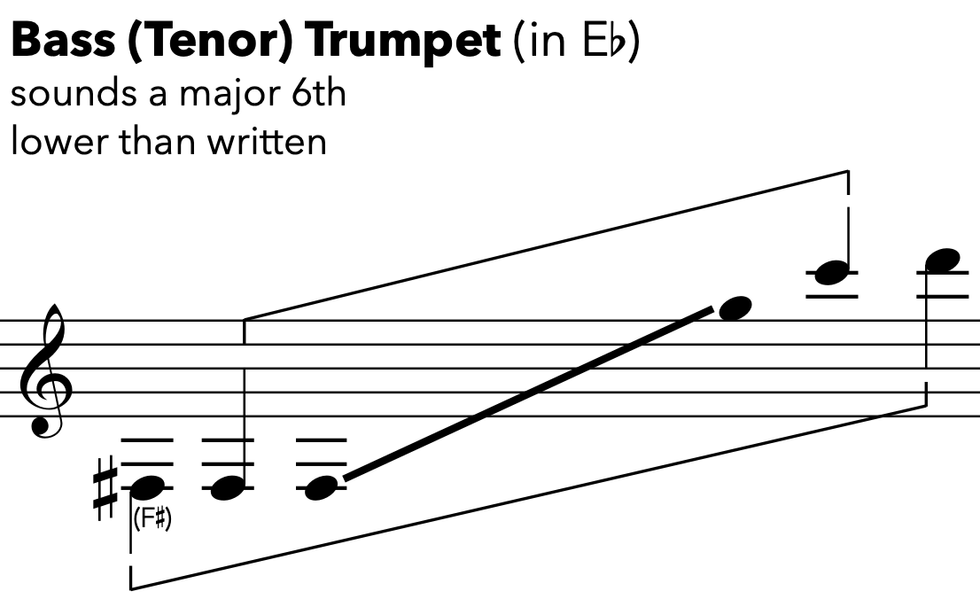


The tenor trumpet has several key characteristics: it is pitched in E♭, sounding a fourth below written pitch, and features a larger bore size than standard trumpets while remaining smaller than bass trumpets. Its more conical bore design contributes to its distinctively warmer tone.
The tenor trumpet is primarily used in specific orchestral works and brass bands, though its use is relatively uncommon in modern performances. Some historical works from the Romantic period occasionally call for this instrument, but parts are often adapted for other brass instruments due to the scarcity of tenor trumpets.
Bass Trumpet (in Bb)
The bass trumpet is a lower-pitched variant of the standard trumpet, typically pitched in B♭ or C and sounding an octave lower than the standard trumpet. It features a larger bore size and bell diameter than a standard trumpet, producing a rich, dark tone that bridges the gap between the trumpet and trombone ranges.
The bass trumpet has several key characteristics that define its unique nature. It combines the agility of a trumpet with a warmer, more robust tone quality similar to a tenor trombone, while being physically larger than a standard trumpet with a wider bore and bell. This distinctive instrument is most commonly found in Wagner's operas and some contemporary orchestral works.

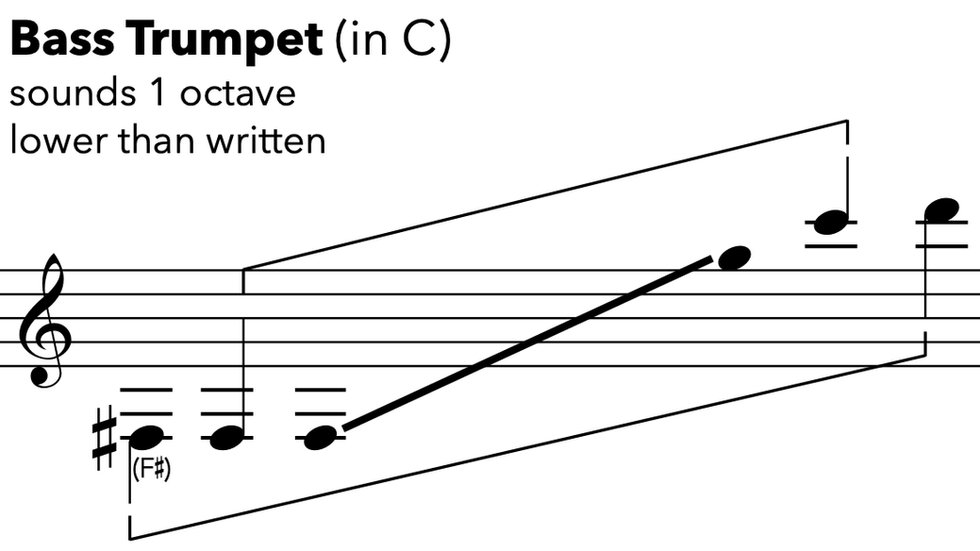




Notable works featuring the bass trumpet include:
Wagner's "Ring Cycle": Features prominent bass trumpet parts throughout, especially in "Das Rheingold" and "Die Walküre"
Stravinsky's "The Rite of Spring": Uses the bass trumpet for its distinctive dark timbre
Holst's "The Planets": Features the bass trumpet in several movements, particularly in "Mars"
Notation
Modern trumpet notation follows these conventions:
Clef
All trumpets read treble clef exclusively
Bass clefs may appear in the score for lower trumpets, but the performer's part should always be written in treble clef
Range
Ledger lines are preferred over 8va markings
Octave markings may appear in the score, but the performer's part should always be written with ledger lines
Techniques
Basic Trumpet Techniques:
Tonguing: Basic articulation using "ta" or "da" syllables
Lip slurs: Smooth transitions between notes in the same harmonic series
Ornaments:
Trills: Rapid alternation between adjacent notes
Falls: Downward glissando effect
Shakes: Rapid alternation between two notes using lip tension
Turns: Quick melodic figures that circle around the main note
Grace notes: Quick decorative notes before the main note
Extended Techniques:
Double tonguing: Rapid articulation using "ta-ka" or "da-ga" patterns
Triple tonguing: Using "ta-ka-ta" or "da-ga-da" patterns
Flutter tonguing: Rolling the tongue while playing
Half-valve effects: Partially depressing valves for special effects
Pitch bends: Manipulating pitch through lip tension and valve slides
Growling: Creating a rough tone by vocalizing while playing
Multiphonics: Playing while singing to create multiple pitches
Pedal tones: Very low notes below the normal range
Mutes
Trumpet players use several types of mutes to modify their instrument's sound. Players should note that mutes typically raise the pitch of the instrument slightly, requiring compensation in tuning.
Unless otherwise specified, when a composer calls for a mute, they are referring to a straight mute. However, several other muting options are available.
Straight Mute: The most common type, producing a bright, focused, and somewhat nasal tone. Made of metal, plastic, or fiber, it's inserted directly into the bell.
Cup Mute: Features a cup-shaped extension that creates a darker, more distant sound. Commonly used in jazz ballads and orchestral works.
Harmon Mute: Also known as a "wah-wah" mute, it creates a distinctive buzzing tone. Players can manipulate the stem to create various effects. Particularly associated with jazz music.
Plunger: Usually a modified toilet plunger, held by hand against the bell to create "wah" effects. Common in jazz and blues playing.
Practice Mute: Designed to significantly reduce volume for quiet practice. Features heavy sound dampening but may affect intonation.
Bucket Mute: Creates a mellow, diffused sound by directing the sound into a larger cavity. Popular in jazz arrangements.
Common mute notations in scores include:
con sord. (with mute)
senza sord. (without mute)
open (remove mute)
Construction and Design
The design of each trumpet type varies slightly to achieve specific tonal characteristics while maintaining these basic construction principles. Professional instruments often feature additional features like adjustable valve slides, heavy-wall construction, or specialized bell tapers.
The modern trumpet's construction consists of several key components that work together to produce its distinctive sound:
Main Components
Leadpipe: The initial tube where the mouthpiece is inserted, crucial for establishing the instrument's response characteristics
Tuning Slide: A U-shaped sliding section that allows for overall pitch adjustment
Valve Section: Contains three piston valves (sometimes four) that redirect air through additional tubing
Bell: The flared ending that projects the sound and influences tone quality
Materials
Brass: The primary material, typically yellow brass (70% copper, 30% zinc)
Silver or Gold Plating: Optional finishes that can affect both appearance and sound
Nickel or Monel: Sometimes used for valve pistons for durability
Valve System
Three piston valves lower the pitch by:
First valve: One whole step (2 semitones)
Second valve: One half step (1 semitone)
Third valve: One and a half steps (3 semitones)
Combinations of valves create additional intervals
Dimensions
Total tube length: Approximately 4.5 feet (1.37 meters) when unwound
Bore size: Varies from .458" to .472" (11.6mm to 12mm)
Bell diameter: Usually 4.5" to 5" (114mm to 127mm)
Nomenclature and Language
A person who plays the trumpet is called a trumpeter in English. This term is widely used across both American and British English, though trumpet player is also commonly accepted. The term trumpetist exists but is less frequently used.
Below is a reference table showing the terminology for trumpets across major European languages, as commonly found in musical scores and orchestral parts:
English | Spanish | French | German | Italian |
Trumpet | Trompeta | Trompette | Trompete | Tromba |
Trumpeter | Trompetista | Trompettiste | Trompeter | Trombettista |
Piccolo Trumpet | Trompeta piccolo | Petite trompette | Piccolotrompete | Tromba piccola |
Bass Trumpet | Trompeta bajo | Trompette basse | Basstrompete | Tromba bassa |
Flugelhorn | Fliscorno | Bugle | Flügelhorn | Flicorno |
In orchestral scores and parts, these instruments are often abbreviated:
Concert Trumpet: Tpt.
Piccolo Trumpet: Picc. Tpt.
Bass Trumpet: B. Tpt.
Flugelhorn: Flug.
Multiple trumpets in an orchestra are typically numbered (e.g., Tpt. 1, Tpt. 2, Tpt. 3)
Historical Development
The trumpet's evolution spans thousands of years, from ancient signaling devices to the sophisticated instrument we know today. This evolution has transformed the trumpet from a simple signaling device into one of the most versatile and expressive instruments in modern music.
Ancient Origins (Before 1500 BCE)
Early trumpets were simple tubes made from animal horns, shells, or hollow branches
Ancient civilizations like Egypt and China developed metal trumpets for military signals and ceremonies
The Roman "tuba" and Hebrew "shofar" were among the earliest documented trumpet-like instruments
Medieval and Renaissance Period (500-1600)
Natural trumpets without valves were used in European courts and military
The "straight trumpet" design emerged, featuring a long cylindrical tube with a flared bell
Limited to playing notes in the harmonic series, requiring great skill for melodic passages
Baroque Era (1600-1750)
Development of the "clarino" playing style for high register performance
Trumpet gained prominence in orchestral music
Bach and Handel wrote significant works featuring trumpet
Classical and Early Romantic Period (1750-1820)
Experiments with keys and holes to achieve chromatic notes
Introduction of crooks (additional lengths of tubing) to change the instrument's key
Decline of clarino playing as musical tastes changed
Valve Development (1810s-1830s)
Heinrich Stölzel and Friedrich Blühmel invented the first practical valve systems
Three-valve system became standardized by 1850
Allowed trumpeters to play all chromatic notes with improved intonation
Modern Era (1850-Present)
Development of various trumpet types (B♭, C, D, E♭, piccolo)
Improvements in manufacturing precision and materials
Integration into diverse musical styles from classical to jazz
Sources
Baines, Anthony. "Brass Instruments: Their History and Development." Dover Publications, 1993.
Blatter, Alfred. "Instrumentation and Orchestration." 2nd ed., Schirmer Books, 1997.
Cascelli, Antonio. "The Cambridge Companion to Brass Instruments." Cambridge University Press, 2019.
Collins, Timothy. "The Evolution of Trumpet Design: Historical Perspectives." Brass Bulletin International, 2020.
Dahlqvist, Reine. "The Keyed Trumpet and Its Greatest Virtuoso, Anton Weidinger." Brass Research Series, No. 1, 1975.
Grove Dictionary of Musical Instruments, 2nd Edition. Oxford University Press, 2014.
Herbert, Trevor. "The Trumpet Book." Yale University Press, 2019.
Moore, James. "Acoustics of Brass Instruments." Journal of the Acoustical Society of America, 2016.
Sachs, Kurt. "The History of Musical Instruments." Norton & Company, 1940.
Sherman, Roger. "The Trumpeter's Handbook: A Comprehensive Guide." Oxford University Press, 2018.
Tarr, Edward. "The Trumpet Book: A Comprehensive Guide to the Instrument, its History and Performance Practices." Amadeus Press, 2008.
Wallace, John and Alexander McGrattan. "The Trumpet Book: Evolution and History of the Trumpet." Yale University Press, 2011.
Whitener, Scott. "A Complete Guide to Brass: Instruments and Technique." Cengage Learning, 2015.